
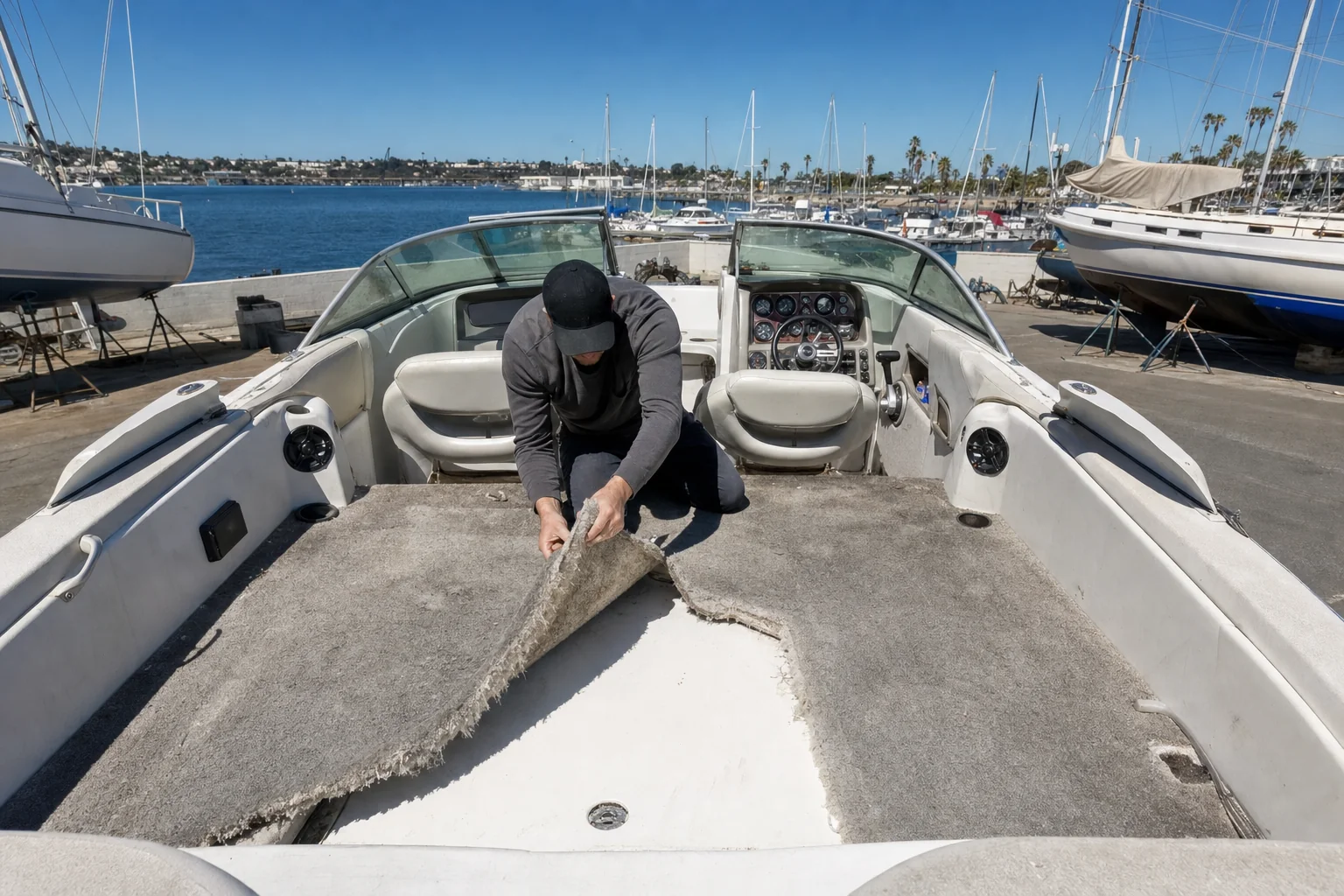
Is Your Boat Carpet Telling You It's Time to Go?
If you’ve been putting off boat carpet replacement, your boat’s floor is probably already sending clear signals — waterlogged padding that never fully dries, a persistent mildew smell no amount of scrubbing removes, fibers that mat flat and turn gray, or soft spots where the subfloor has absorbed moisture underneath. Marine carpet is one of the most common original flooring choices on production boats, but it has a fundamental weakness: it traps water. Once that happens, the padding beneath becomes a sponge, and the rot cycle begins. Recognizing the right moment to pull it out — and knowing what goes in its place — can save you money and protect the structure of your hull.
Why Marine Carpet Wears Out Faster Than You'd Expect
Boat carpet lives in one of the harshest environments any textile can face. UV exposure breaks down fibers and fades color. Salt water and sunscreen residue accelerate degradation. Foot traffic on a moving deck creates friction that land-based carpet never experiences. And unlike a living room rug, marine carpet rarely gets a chance to fully dry between uses, especially in San Diego’s year-round boating culture where boats go out frequently and sit in slips between trips.
Most marine carpet has a useful life of three to seven years depending on use frequency, climate, and how well it drains. Boats that stay wet — fishing boats, pontoons used for swimming, boats kept in covered slips — tend to wear through carpet faster. Once the backing separates or the padding compresses unevenly, no cleaning product will restore function or appearance.
What Goes In After the Carpet Comes Out
When it’s time to remove boat carpet, the old material comes out, the subfloor is inspected for moisture damage, and a new surface goes in — cut to fit your specific boat. Here are the replacement materials we work with.
**Closed-cell foam decking — EVA or XPE:** Both are closed-cell foam materials that don’t absorb water, feel soft underfoot, and provide solid grip when wet. EVA foam is the more affordable of the two and works well on most boats. XPE (cross-linked polyethylene) is denser: it holds its shape better under California’s sun and resists pressure marks from deck chairs and coolers, making it the better choice if you want the deck to look good for many years. Both come in a wide range of thicknesses (3 mm, 5 mm, 6 mm, and 12 mm are common) and patterns like teak plank, diamond, hexagon, fish scale, gator scale, topographic, and border-line designs. With 20-plus color options and two-tone combinations, either material can be tailored to match your boat’s aesthetic. Custom logos are also possible. This category is often compared to brands like SeaDek or GatorStep, though independent fabricators can produce fully custom pieces to the exact dimensions of your boat.
**Marine-vinyl (AquaMat-style):** Made from PVC combined with marine-grade yarn, woven vinyl flooring looks sharp, resists UV, and drains quickly through its open weave. Collections like Teak II, Lakeport Plank, and Riptide offer different visual styles from classic teak-look to modern nautical. It’s a strong choice for pontoon boats and larger cabin boats where aesthetics matter as much as function.
**Why carpet comes out:** Marine carpet traps water, compresses unevenly, and eventually transfers moisture to the subfloor. Removing it and replacing it with closed-cell foam or marine vinyl eliminates that cycle entirely — no padding to saturate, no backing to separate, no mildew to scrub.
**A note on rubber mats:** Rubber matting is sometimes placed over existing boat floors, but it traps moisture underneath rather than eliminating it — which means the subfloor problem continues. Custom-cut closed-cell foam or woven marine vinyl replaces the carpet entirely and removes that moisture cycle at the source.
The Importance of a Precision Fit
One of the biggest mistakes in any boat flooring project is cutting corners on the template. Boat floors are not flat rectangles. They have hatches, rigging cutouts, pedestal bases, livewells, built-in coolers, and curved hull sides. A generic or hand-traced template produces gaps, lifted edges, and pieces that shift underfoot — all of which look unprofessional and wear faster at the edges.
The professional approach uses a Proliner 3D digital scanner to capture the exact geometry of your floor at your slip, marina, or driveway. The resulting digital file drives a CNC cutter, which produces pieces accurate to the millimeter. You review a 3D design rendering before a single piece is cut, so there are no surprises. This process typically results in a finished install within two to four weeks from the initial scan.
San Diego-Specific Considerations
San Diego’s mild, sunny climate is a gift for boating — and a challenge for flooring. The combination of intense UV, salt air from the bay and ocean, and year-round use means flooring materials get more cumulative stress here than in seasonal boating markets. EVA foam handles this environment well and is a practical choice for most boats. XPE’s greater density gives it an edge in resisting long-term sun compression and pressure marks — worth the step up if your boat sits in an exposed slip or sees heavy use. Marine vinyl is equally solid in this environment. A five-year warranty on both materials and workmanship is a reasonable benchmark to look for when evaluating any installer.
If you’re ready to remove the old carpet and replace it with closed-cell foam (EVA or XPE) or marine vinyl, a free quote and on-site scan is the logical first step.